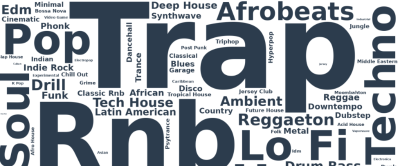
While the quality of music may ultimately be a matter of personal taste, modern factors—such as technological iteration, cultural exchange, contextual segmentation, and audience feedback—have undoubtedly reshaped the trajectory of popular music. Among these factors, certain controversial elements have nonetheless endowed the contemporary music industry with positive significance regarding its structural commercial and cultural transformations—notably, the influence of technology and the trend toward universal accessibility. Of these myriad factors, however, the "overextension" of musical genres appears to be the pivotal force driving the alteration of popular music's trajectory. This "overextension" of genres manifests primarily in two ways: first, the hybridization of genres has become the predominant method for creators to innovate; and second, the fragmentation of genre definitions has caused them to lose their original capacity to distinguish between distinct musical styles.
Non-Mainstream Cultures
The concept of "World Music" originated in Germany during the 1930s. At that time, a number of modern musicians, having grown weary of indigenous European popular music, yearned to explore musical styles lying beyond the mainstream. They traveled to regions such as Hungary, Romania, and Yugoslavia to conduct in-depth fieldwork and collect folk melodies, subsequently utilizing Western musical techniques and forms to compose new works. By incorporating a wealth of modern harmonic techniques, these musicians successfully forged a novel musical style—one imbued with the unique cultural characteristics of various ethnic groups. Although the specific appellation "World Music" had not yet been coined at the time, its fundamental framework and underlying philosophy were already taking shape.
Originating in the 1930s, the concept of World Music—nurtured by the efforts of various musicians—gradually evolved into a specific terminological category encompassing music from outside the Euro-American sphere.
Although these musical forms originated in non-mainstream cultural regions, their integration of modern musical elements has gradually fostered a musical landscape characterized by greater inclusivity and diversity.
The New Life of World Music
With the advancement of electronic music and modern compositional techniques, an increasing number of musicians are now fusing elements of World Music with popular music, thereby enriching the diversity and innovative spirit of the musical landscape. A growing number of musicians and bands are dedicating themselves to the in-depth study and preservation of their own indigenous musical traditions, striving to showcase to the global stage the ancient yet captivating power of their ethnic music. They focus on the creation of "primal" or authentic folk music, offering listeners a pure and unadorned musical experience; concurrently, they blend these distinct ethnic characteristics with elements of modern pop music, enabling a wider audience—amidst the currents of mainstream pop—to experience the profound, transformative power of authentic indigenous music. For instance, Choduraa Tumat—an ethnic musician hailing from Tuva—was deeply immersed in Tuvan musical traditions from an early age. Not only is she a virtuoso on the sihu (a traditional Tuvan string instrument), but she also performs khoomei (Tuvan throat singing) while accompanying herself on the instrument—thereby challenging the long-standing cultural norm that Tuvan women do not engage in throat singing.

New Strategies and Subcultures
Dissemination Strategies in the Streaming Era
In today's music market, prominent international labels such as 88rising and HYBE have demonstrated a profound understanding of "streaming" as a key medium for reaching younger audiences. Contemporary labels excel at leveraging streaming platforms for content distribution and artist branding, thereby accelerating the viral spread of music and the rapid rise of musicians. They skillfully utilize these platforms to craft a comprehensive song marketing strategy—encompassing everything from artist packaging and song promotion to user-generated content (UGC) campaigns. This strategy has yielded remarkable results on short-video and music streaming platforms, not only driving the widespread dissemination of songs but also fueling the meteoric rise of the musicians behind them.